
From Tech Innovator to Rehabilitation Pioneer: Tal Koren’s Journey at Reuth
- Dikla Tuchman
- News
Meet Tal Koren, a Tel Aviv high-tech professional working at the AI startup Knostic, who refused to let a diagnosis of a rare disease stand in his way. During his rehabilitation at Reuth Rehabilitation Hospital in Tel Aviv, Tal came up with an extraordinary idea: to design and 3D-print assistive devices to support his therapy and recovery.
In May, after suffering from a stomach virus, Tal began to feel tingling in one finger of his left hand. The sensation gradually spread to both hands and his legs. After a series of tests, he was diagnosed with Guillain-Barré Syndrome.
“I was very anxious because I didn’t know what this syndrome was,” Tal recalls. “I felt like my body had betrayed me, even though I live a healthy lifestyle and stay fit. Only when I arrived at Reuth did I fully understand what I was facing. The muscle weakness spread to other parts of my body and almost reached my facial and swallowing muscles. At first, I needed full assistance with everything, including eating, and I used a wheelchair. After a month of intensive therapy and hard work, I managed to stand up, and that was an incredible feeling. That success motivated me to keep going, and today I’m already walking.”
Tal describes the care at Reuth as exceptional. “I felt the team’s deep commitment to my rehabilitation process. Sometimes I didn’t even notice my progress because it happens through many small successes. But nothing escapes the professional eyes of the staff.”
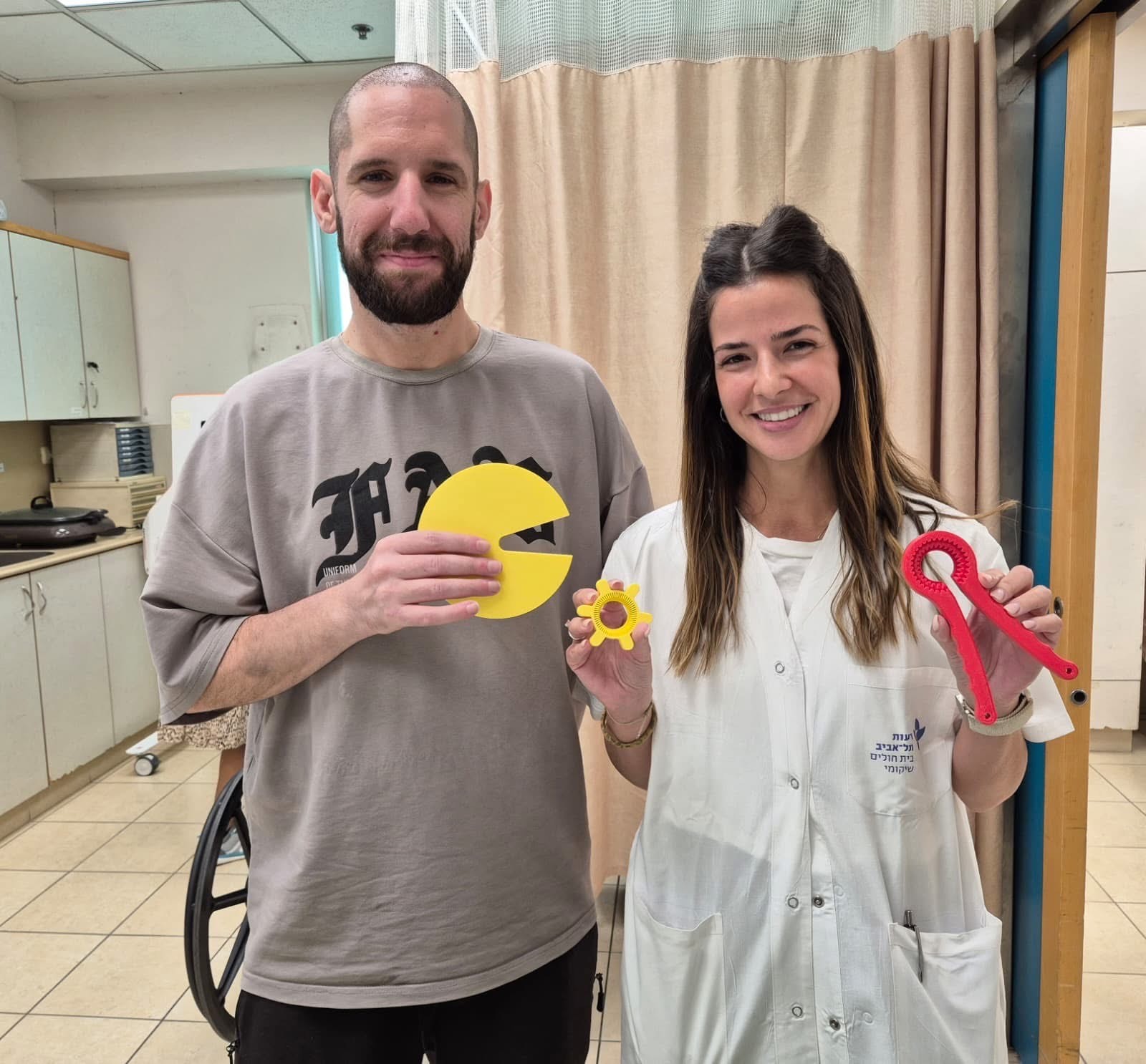
As part of his occupational therapy for fine motor skills, Tal came up with the idea to 3D-print tools that could assist in therapy. “The recovery of my hand function has been slower, and I still experience muscle weakness,” he says. “Since I have a 3D printer at home, I printed bottle openers in various sizes based on an online model, which help me in daily tasks. I also designed and printed my own tool—a small disc shaped like Pac-Man—that helps me strengthen my fingers and joints. It allows me to practice each finger independently without needing staff assistance.”
Tal also printed additional sets of these devices for the therapy team, so other patients could benefit from them as well.
Recently discharged from inpatient rehabilitation, Tal continues his recovery in Reuth’s day program. “My story taught me the power of optimism and how crucial it is in any rehabilitation or medical process,” he reflects. “It’s easy to fall into negative thoughts, but it’s important to rise above them and keep moving forward.”
In the photo: Tal Koren and occupational therapist Almog Aviv, with the innovative 3D-printed therapy devices.
May interest you
Eli Beer's Miracle
- etamaro
- English
22/04/2024, Yediot Ahronot Passover Supplement:"A Ballad of a Medic and a Doctor"
- etamaro
- English
A Life Saved, a Life Rebuilt: Stroke Survivor Completes Intensive Rehabilitation at Reuth
- Dikla Tuchman
- News